
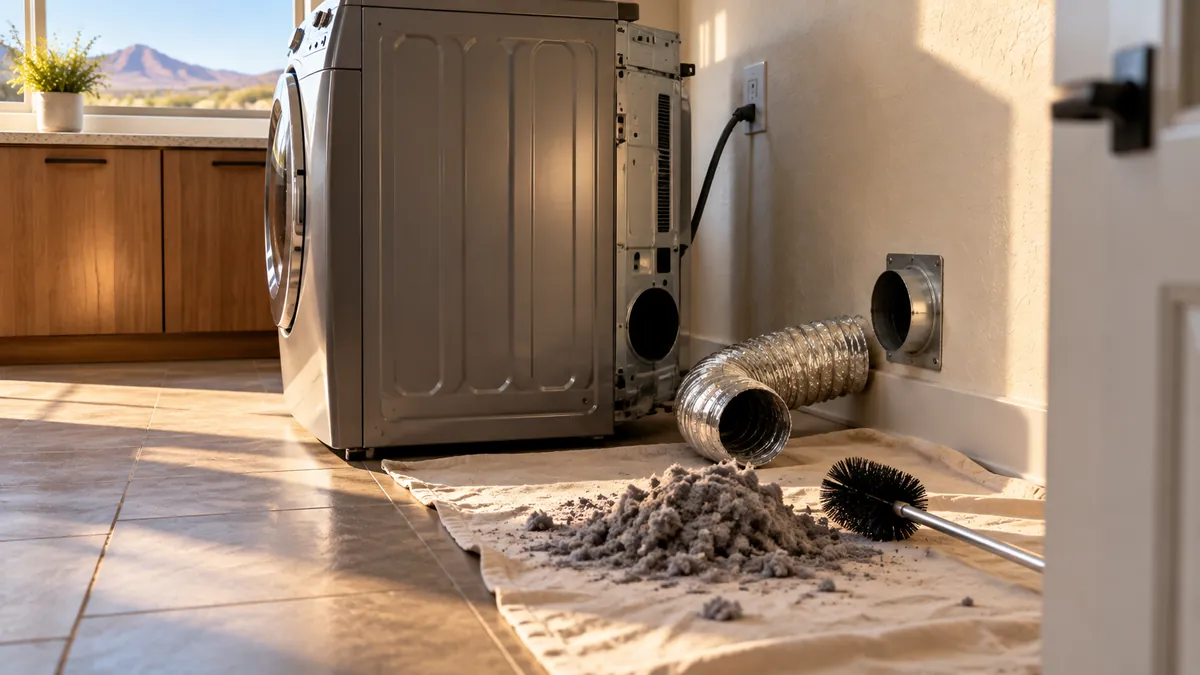
We clear lint from dryers and ducts
Cleaning Resource Center inspects the lint compartment and duct work on commercial dryers around Phoenix. We remove the lint we can reach and add access panels where a run has no way in.
We start at the lint compartment
Every commercial dryer job starts inside the machine. We open the lint compartment and look at what has collected there. The lint screen catches most of it, but a fine layer always gets past and packs into the compartment and the first stretch of duct. On a dryer that runs from opening to closing, that layer grows faster than most owners expect, and it sits right next to the heat.
Then we inspect the duct work and trace it from the back of the dryer toward the point where it leaves the building. We look for lint packed into the elbows, where the air slows and lint settles. We also look for joints that have pulled apart and are blowing lint into a wall or a ceiling instead of outside. What we find tells us where the run can be reached and how the cleaning has to go.
Cleaning means removing all the lint we can reach, from the compartment and along the duct. Some runs were built with no way in at all. They pass above a ceiling or behind a wall with no opening along them. Cleaning from the two ends never reaches the middle. Where that is the case, we install an access panel so the duct can be reached and cleaned. The panel stays in place, so the next cleaning has a way in as well.
- Lint compartment inspected and cleaned out
- Duct work inspected for lint and blockages
- All accessible lint removed from the duct
- Access panels installed where a run needs one
- Laundry exhaust cleaned along with dryer vents
Lint in the duct makes dryers overheat
A dryer needs to push its hot, wet air out of the building quickly. When lint narrows the duct, that air backs up. The load takes longer to dry, and the heat stays in the drum and the cabinet instead of leaving. Staff usually notice longer cycles or clothes that come out damp, and they run a second cycle to make up for it. That extra run time puts more heat into a duct that is already partly blocked.
Commercial dryers have a high temperature limit switch that cuts the heater when the air inside gets too hot. With a clear duct, it rarely has to act. With a clogged one, it trips over and over through the day, and the heater shuts off and comes back on each time. Most of those switches were never built to cycle that much. Over time they wear out and fail, and the dryer loses one of the parts meant to keep it from overheating.
That is how a lint problem turns into a fire. The Consumer Product Safety Commission estimates about twenty-four thousand clothes dryer fires in the United States each year. Lack of maintenance is the leading cause, and lint is the material that most often ignites. Lint burns easily, and it collects right beside the heater, so a dryer that overheats has fuel sitting within reach. Cleaning the compartment and the duct takes that fuel away.
Phoenix heat and dust make lint worse
In Phoenix, a dryer pushes hot air into places that are already hot. Through the summer, the space above a ceiling or under a flat roof can run hotter than the laundry room below it. The exhaust loses very little heat on the way out, so the lint along the whole run stays hot. Add a partly blocked duct, and the high limit switch trips sooner and more often.
Dust makes it worse. Phoenix gets dust storms during the summer monsoon, and fine desert dust settles on everything outside, the vent cap included. Dust mixes with the lint caught at the outlet and builds into a layer that holds the damper flap partly shut. A cap that nobody checks can stay that way for months. From inside, nothing looks wrong, and the dryer just takes longer to finish a load.
How a building is built decides how hard its dryer duct is to clean. Much of the commercial space around Phoenix is concrete block with a flat roof, so ducts often run up through the ceiling and out the roof. Laundry rooms in stucco and wood frame buildings tend to have long runs with several elbows hidden above drywall. Those long, closed runs are where lint sits the longest, and where an access panel does the most good.
Cleaning the lint screen is not enough
Good laundry staff clean the lint screen after every load, and that habit matters. It does nothing for the lint that already got past the screen. That lint builds up in the compartment and the duct no matter how often the screen is pulled. On a busy dryer it builds up quickly. You cannot judge the duct behind the machine by looking at a clean screen.
Skipping a step leaves part of the problem in place. Brushing the duct from the outside without opening the lint compartment leaves the lint that sits closest to the heater. Cleaning only the two ends of a long run leaves the middle packed, and that middle is often where the elbows are. The dryer may run a little better for a while, then the long cycles come back, because most of the restriction never left.
When the job is done right, the lint compartment is empty and the duct is clear as far as it can be reached. Any run that had no way in now has an access panel, so the next cleaning can get to it. On the dryer side, loads should dry in a normal cycle again, and the laundry room should stop filling with heat. If a load still runs long after a cleaning, the problem is probably in the dryer itself rather than the duct.
Need your dryer vents cleaned?
Call (602) 454-6790, Monday to Thursday from 9:00 AM to 3:00 PM, and we will set up an inspection of your dryer vents.
Rated 4.0 on Google
We have not reprinted any of them here. The link opens our Google profile so you can read them at the source, which is worth more than a quote we picked ourselves.
Call now for a free vent inspection
The clearest sign is a dryer that takes longer to dry a load than it used to, so staff start running extra cycles. A laundry room that gets hotter than normal is another sign, because heat that should leave through the duct is staying inside.
It can. When hot air cannot get out, the high temperature limit switch shuts the heater off and on all day to control the heat. That constant cycling wears the switch out, and a worn switch can fail.
Some ducts were closed inside a ceiling or a wall when the building went up, with no opening anywhere along them. Lint in the middle of a run like that cannot be reached from the ends. An access panel opens that section so it can be cleaned now and at every cleaning after.
No. A dryer duct carries hot, lint-filled air from the dryer to the outside of the building. Your heating and cooling ducts are a separate system, and cleaning them is a separate service.
Yes. We clean dryer vents and laundry exhaust, and both start with an inspection of the duct work. Tell us how many dryers the room has when you call, so we know what to plan for.
Yes, every job starts with an inspection of the lint compartment and the duct work, which shows us where the lint is. Free inspection is one of the services on our Google listing, so ask about it when you call.
Tell us about your kitchen.
Call us or send your details, and we will set up a free inspection of your exhaust.
- Monday to Thursday9:00 AM to 3:00 PM
- Friday to SundayClosed