
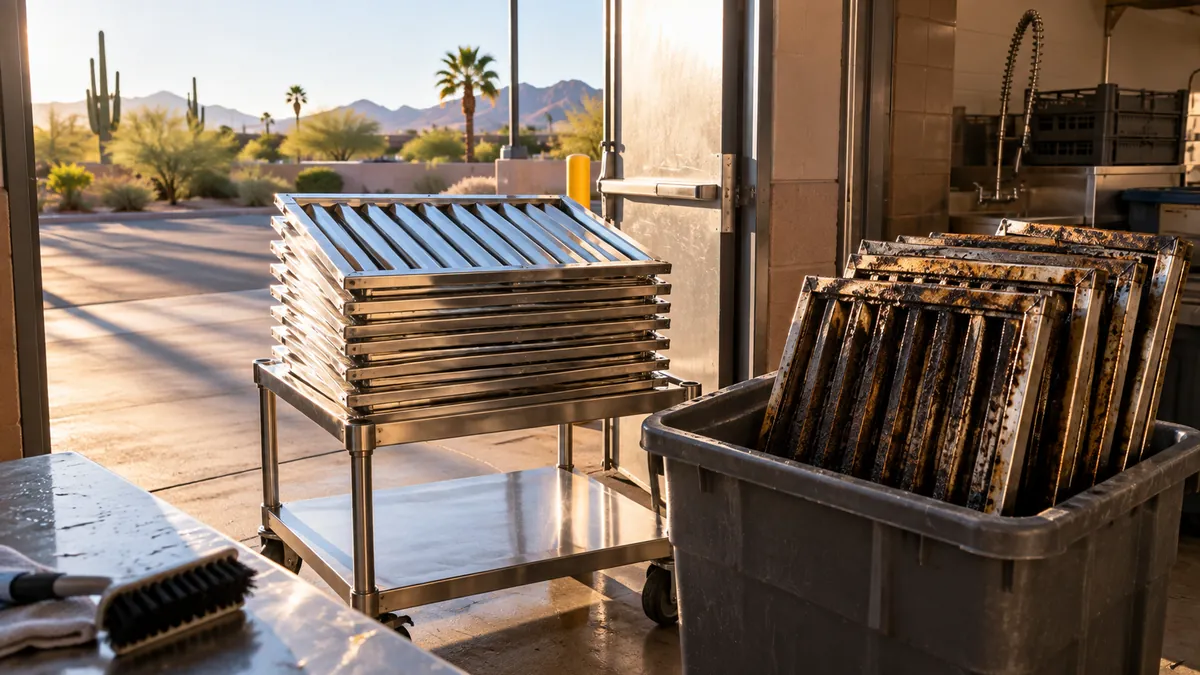
Every filter goes through five steps
We pick up the greasy filters from your kitchen hood and bring them back clean. 4.0 from 4 Google reviews.
We clean filters in a set order
A hood filter is the first thing grease hits when it rises off the grill or the fryer. The slanted metal channels catch the droplets riding up in the smoke, so less of that grease reaches the duct above. That only works while the channels stay open. Once they fill, grease passes straight through and heads for the duct. The fan has to pull harder, and grease starts dripping back toward the cook line.
Our filter exchange runs in five steps, and the order matters. We pick up the dirty filters from your kitchen. They go into a chemical dip first, because the dip is what softens grease that has cooked on over weeks of service. After the dip, each filter is sanitized. The pressure wash comes next, and it pushes the loosened grease out of the channels instead of just off the face. Last, we bring the filters back to you.
When a filter is done right, it looks like bare metal on both sides. Hold it up and you should see light through the slots between the channels. There is no brown film in the folds and nothing tacky along the edges where your cooks grab it. If you still see dark streaks deep in the channels, the grease only came off the surface, and the filter will fill again much sooner.
- Pickup of dirty filters from your kitchen
- Chemical dip to soften baked-on grease
- Sanitation of every filter after the dip
- Pressure wash through every channel
- Clean filters returned to your kitchen
Each skipped step causes its own problem
Pressure washing a greasy filter without soaking it first looks fast and does very little. Grease that has been cooked by weeks of heat turns hard and dark, close to varnish, and water alone skids right across it. The face of the filter comes out shiny while the inside of every channel keeps its coat. That leftover layer is the part that matters, because it is where new grease grabs on first.
Sanitation is the step people forget about. A hood filter hangs right over the food you cook, and old grease holds on to bits of food and a sour smell. Sanitizing after the dip means the filter comes back clean to the touch and does not carry that smell back into your kitchen. It also helps at inspection time, because an inspector who looks up at a dirty hood tends to keep looking.
The worst mistake is waiting too long between cleanings. Filters left too long get so loaded that grease runs off the bottom edge and onto the cook line below. A flare-up from a burner can reach a loaded filter, and a filter packed with grease will burn. Keeping filters clean is one of the simplest ways to stop a small flare from turning into a kitchen fire.
Phoenix heat and dust fill filters faster
A Phoenix kitchen fights heat from both sides. The line is hot all day, and for much of the year the air coming in the back door is hot too. Grease stays thin and runny in that heat. More of it rides up into the hood, and more of it drips back through the filter channels. A filter that held up fine through January can fill much sooner in July.
Dust is the other problem. When a monsoon dust storm rolls across the Valley, fine dirt blows in every time a door opens. The hood pulls that dusty air straight up through the filters. The dust lands on wet grease and sticks. Grease and dirt together make a thick paste that is harder to lift than grease alone, and it closes up the channels faster.
Many Phoenix restaurants work out of strip centers built from concrete block with stucco over it. Those kitchen spaces change hands often. A new tenant usually takes over the old hood, along with whatever grease the last owner left in the filters. That means the first cleaning after a change in tenants is often the heaviest one. After that, a regular schedule keeps each cleaning much lighter.
Your hood shows when filters need cleaning
You do not have to guess when filters are due. Look up at the hood while the line is running. Smoke rolling out past the front edge, instead of getting pulled up, usually means the filters are choked. Grease beading along the bottom lip of the hood is another sign. So is a sticky film on the ceiling right beside the hood, which means grease is getting past it.
Some kitchens run filters through the dish machine between visits. That takes off loose grease on the surface. It does not reach what has baked into the channels, and it leaves a greasy mess in the machine. Scraping with a knife is worse. It bends the metal, and a bent filter leaves gaps where grease slips past into the duct. A filter should sit flat and snug in the hood.
How often your filters need the exchange depends on what you cook and how much of it. A kitchen running fryers and a charbroiler all day fills filters much faster than one that mostly steams and bakes. We can look at your hood during a free inspection and tell you what we see on the filters. From there you can set a regular schedule that fits how busy your kitchen is.
Get your hood filters picked up
Call (602) 454-6790 Monday to Thursday, 9:00 AM to 3:00 PM, to set up a pickup for your filters.
Rated 4.0 on Google
We have not reprinted any of them here. The link opens our Google profile so you can read them at the source, which is worth more than a quote we picked ourselves.
Call now for a free cleaning quote
They go through five steps in this order: pickup, chemical dip, sanitation, pressure wash and return. The dip comes first so the pressure wash can push the softened grease out of the channels instead of just cleaning the face.
No. The exchange covers the filters that sit in your hood. The duct and fan above them are cleaned as part of our kitchen exhaust hood cleaning, which is a separate service.
Watch the hood while the line is running. If smoke drifts out past the front edge or grease beads along the bottom lip, the filters are likely full. A free inspection will tell you for sure.
Phoenix heat keeps grease thin and runny, so more of it rides up into the hood and gets caught in the filters. Monsoon dust sticks to that grease and forms a paste that closes the channels sooner.
Yes. A filter packed with grease can catch when a flare-up reaches it, and a clean one gives a flame much less to burn. Keeping filters clean is one of the simplest fire safety steps a kitchen can take.
We work out of Phoenix and serve kitchens in Tempe, Glendale, Scottsdale, Peoria, Mesa, Chandler, Gilbert, Goodyear and Surprise. Call (602) 454-6790 Monday to Thursday to set up a pickup.
Tell us about your kitchen.
Call us or send your details, and we will set up a free inspection of your exhaust.
- Monday to Thursday9:00 AM to 3:00 PM
- Friday to SundayClosed