
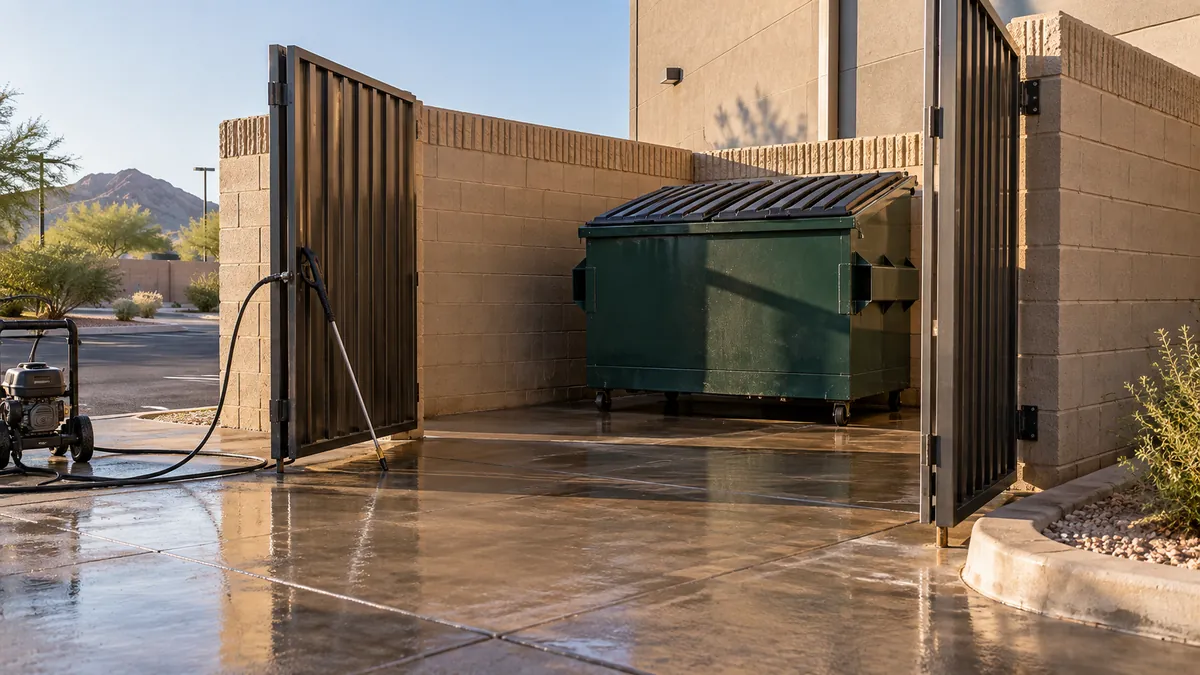
We treat stains before we pressure wash
Cleaning Resource Center washes Phoenix businesses. We clean drive thrus, dumpster pads, sidewalks, parking garages and building walls. Your bid lists exactly which areas we clean. You see it before any work starts.
Every job starts with a written bid
Before any water hits the ground, we look over the property and write down what gets cleaned. The bid names each area by where it is, like the sidewalk along the storefront or the dumpster pad out back. A garage level with oil spots gets named by level. If a spot is not on the bid, it is not part of the job. That sounds basic, but it is where most arguments about power washing start.
The order of the work matters as much as the pressure. Stains get a biodegradable cleaning agent first, picked for what the stain is. Grease on a dumpster pad does not come up with the same cleaner as gum on a sidewalk. The agent needs a few minutes to loosen the stain before any pressure goes on it. Then the concrete spinner covers the open concrete, and the wand handles curbs and the edges the spinner cannot reach.
The last pass is a rinse that pushes the loosened dirt off the concrete instead of letting it dry back in place. Done right, the slab is one even color from edge to edge, with no dark patches where a stain was only half lifted. Skip the pretreatment and you get concrete that looks clean while it is wet, then dries with the old stains showing right through it again.
- A written bid naming every area we clean
- Stains pretreated with a biodegradable cleaning agent
- Concrete spinner on sidewalks and drive thru lanes
- Dumpster pads degreased and rinsed
- Building walls washed from the top down
A spinner cleans concrete without leaving stripes
Most striped concrete comes from a wand held by hand. The spray hits hardest right under the nozzle, and a person sweeping it back and forth never holds the same height or speed for long. Each pass cleans a strip, and where the strips overlap unevenly you see light and dark bands across the slab. People call it zebra striping, and once the concrete dries it is hard to hide.
A concrete spinner is a round cover that rides on the ground with a spinning bar underneath it. Nozzles on the bar spray from the same distance the whole time, so every part of the slab gets the same cleaning. The cover also keeps the spray contained. That stops dirty water from blasting onto storefront glass or the cars parked nearby, which a wand does all the time.
Most sidewalks and drive thru lanes around Phoenix are poured with a broom finish. It is a rough texture that helps tires and shoes grip. That texture holds dirt down in small grooves. A wand tends to clean the tops of the ridges and leave the grooves gray. So the slab looks blotchy up close. The spinner works the whole surface evenly, which is why it does the best job when concrete is very dirty.
Phoenix heat bakes grime into concrete
Concrete in Phoenix sits in hard sun most of the year, and a dark slab in July gets hot enough to burn a bare hand. Oil that drips from a car idling in a drive thru lane or parked on a garage deck lands on that hot surface. Heat thins the oil, so it runs deeper into the pores before it sets. The longer it sits, the harder it is to lift.
Dust is the other constant. The summer monsoon brings wind storms that coat walls and walkways in a fine film. The first rain after a storm turns that film into muddy streaks down the side of a building. Hard water adds its own problem. Phoenix tap water carries a lot of minerals, and when it dries on warm concrete or glass it leaves chalky white spots behind.
Heat also changes how the washing itself has to go. A cleaning agent sprayed on a hot slab can dry in place before it does anything, and dried cleaner leaves a haze of its own. So the concrete gets wet down first to cool it off. The agent then goes on in sections small enough to stay damp, and each section gets rinsed before the sun can bake it on.
Stucco and block walls need gentle pressure
A lot of the strip centers and office buildings around Phoenix are built of concrete block. Some are finished with stucco, and some are left as split-face block, which has a rough face that looks like cut stone. Both hold dust in their texture. Both also get dirtiest along the bottom, where sprinklers splash and runoff hits the wall. A building that looks dull from the parking lot is often a lighter color under a layer of desert dust.
Stucco is the one to be careful with. It is a thin cement coat over the wall. A tight stream of high pressure can gouge it, or push water through a hairline crack into the wall behind. On stucco the right approach is to let the cleaning agent do most of the work. The pressure stays low, and the wand is held well back from the surface.
Walls get washed from the top down. That way dirty water runs over areas that still need cleaning instead of streaking the parts that are already done. Windows and doors along the wall get rinsed at the end, because spray from the wall work lands on the glass. When a wall is done right the color is even from the roofline to the sidewalk. You should not see a clean band at head height with a dirty one above it.
Dumpster pads need washing on a schedule
A dumpster pad behind a restaurant or grocery store collects grease and the liquid that leaks out of trash bags. In the Phoenix heat that mess starts to smell within days, and it draws flies to the back door. It also makes the concrete slick, and the people carrying trash out at closing time are the ones who slip on it. A drive thru lane picks up the same kind of grime from food and drinks dropped out of car windows.
Grease on concrete does not wash off with water alone. It needs a cleaning agent that breaks it down first, then pressure to lift it out of the pores. A pad that has gone months without a wash has grease soaked deep into it. One wash will make it much lighter, but it will not make old concrete look freshly poured, and anyone who tells you otherwise is guessing.
That is why regular cleaning gets better results than one big wash a year. When a pad or a drive thru lane gets washed on a steady schedule, the grease never settles deep. Each visit takes less work, and the concrete stays close to its original color. We can set up regular cleaning for the areas that get dirty fastest, and wash the rest of the property less often.
Get a detailed bid for your property
Call (602) 454-6790 Monday to Thursday, 9:00 AM to 3:00 PM, and tell us which areas you want washed so we can write up your bid.
Rated 4.0 on Google
We have not reprinted any of them here. The link opens our Google profile so you can read them at the source, which is worth more than a quote we picked ourselves.
Call now for a free cleaning quote
It is a round cover with a spinning bar and nozzles underneath that rides on the concrete. The nozzles stay the same distance from the ground the whole time, so the whole slab gets cleaned evenly. That is what keeps you from ending up with light and dark stripes.
Yes, if the pressure is high and the wand is held close. Stucco is a thin cement coat, and a tight stream can gouge it or push water into a crack. On stucco we let the cleaning agent do most of the work and keep the pressure low.
We use biodegradable cleaning agents, and the one we pick depends on what we are cleaning. Grease on a dumpster pad needs a different cleaner than desert dust on a building wall.
Fresh drips usually lift well after a pretreatment and a pass with the spinner. Oil that has baked into the concrete for a long time can get much lighter without disappearing completely. We will tell you which kind you have when we look at it.
It depends on how much food waste goes into the bins. A pad behind a restaurant gets dirty much faster than one behind an office. Washing on a regular schedule keeps the grease from soaking in, and that gives the best results over time.
The bid lists exactly which areas we are cleaning, like the sidewalk along the front, the drive thru lane or the dumpster pad. If an area is not on the bid, it is not part of the job, so you know what you are paying for before we start.
Tell us about your kitchen.
Call us or send your details, and we will set up a free inspection of your exhaust.
- Monday to Thursday9:00 AM to 3:00 PM
- Friday to SundayClosed