
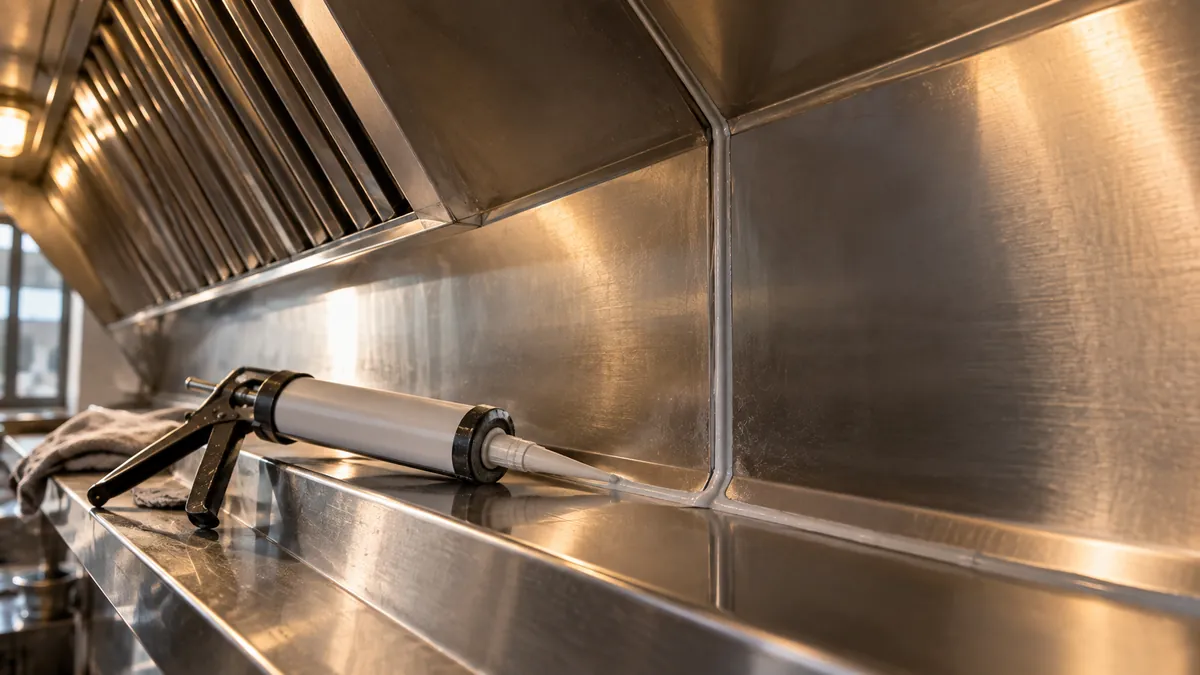
We reseal hoods with fire rated caulk
Dried out caulking opens gaps in the stainless steel seams, and grease leaks through onto the cook line. We strip out the old bead and seal the cleaned seam again.
We reseal your hood in three steps
Every commercial hood is built from stainless steel panels, and each place two panels meet is a seam sealed with a bead of caulk. While that bead is sound, grease that condenses inside the hood runs down the panels into the gutter and the grease cup. Once the caulk dries out and pulls away from the steel, the grease finds the gap instead. It works into the joint and can drip onto the cook line or run down the wall behind the hood.
The order matters. First we cut all the old caulking out of every seam, because new caulk over a cracked bead only sticks to the old bead. Then we clean the seam. Grease settles deep in the joint, and caulk will not bond to grease. The steel has to be clean and dry before anything goes on. Last, we run a new bead of fire rated caulk along the seam and smooth it so it fills the whole gap.
A good reseal is easy to spot. The bead runs unbroken from one end of each seam to the other. There are no skipped corners and no thin spots where bare steel shows through. It sits tight against both panels instead of bridging over old grease. Wipe the hood down a week later and the seams stay clean, with no dark line creeping out of the joints. If the seams on your hood look like that now, they do not need us yet.
- Old caulking cut out of every seam
- Each seam cleaned down to bare steel
- New fire rated caulk along every seam
- Corner joints and upper seams included
- Finished seams checked for gaps and thin spots
Caulk does not stick to greasy steel
Running a fresh bead right over the old one is a common shortcut on this job. It looks fine the day it goes on. The trouble is underneath, where the old caulking is already cracked and loose, and the new bead is only stuck to that. A few weeks of heat and steam move the old layer, and the new one moves with it. The seam opens up again, now with twice the caulk hiding the leak.
Skipping the cleaning is the other way this goes wrong. A hood seam holds a film of grease you cannot always see, and it sits deeper in the joint than a quick wipe reaches. Caulk laid over that film grabs the grease instead of the steel. The seam can look sealed while the edges are already lifting. Grease then gets in behind the bead and leaks the same as before, only now it is harder to spot.
Then there is the caulk itself. A hood hangs right over the fryers and the flat top, and the steel gets hot every service. A general purpose sealant from a hardware store is made for a bathtub or a window frame. Near that heat it can soften and pull away from the panels. That is why every seam we reseal gets fire rated caulk. It is made to hold up under the heat over a cook line.
Phoenix heat and dry air harden caulk
Caulk only seals while it stays a little soft. Phoenix works against that from both sides. The air outside is dry for most of the year, and summer afternoons run well past a hundred degrees. Inside, the hood heats up every service, and in a busy kitchen the steel barely cools off between lunch and dinner. Over months of that, the caulk bakes hard and shrinks back from the steel.
Hard caulk cannot move with the hood. Stainless steel grows a little when it heats and pulls back as it cools. A hood goes through that every time the line fires up and shuts down. A soft bead flexes with the steel. A brittle one cracks, and the cracks tend to open at the corners and along the upper seams first. Each one is a new path for grease to get out of the hood.
Dust gives you an early warning. Summer dust storms push fine desert dust into kitchens across the Valley, and it sticks to anything greasy. On a Phoenix hood, a failing seam often shows up as a dark, gritty line along the joint before it ever drips. If you see that line, the caulk behind it has likely already let go. That is the time to reseal, before the grease reaches your cook line.
Many Phoenix kitchens inherit an older hood
Plenty of restaurants around Phoenix open in strip center spaces built from concrete block, with a stucco finish and a flat roof. When one restaurant closes, the next tenant often keeps the hood that is already hanging there. That saves real money on the build out. It also means the caulk in those seams may be older than the business cooking under it. Nobody on staff knows when it was last done.
Flat roofs matter too. The roof deck over a kitchen soaks up sun all afternoon. The top of the hood is closest to it, where the duct runs up through the roof. Those upper seams get heat from the cooking below and heat from the roof above. When a hood in one of these buildings starts to leak, the seams near the ceiling are a good place to look first.
Newer restaurant buildings in Chandler and Gilbert run into the same thing, just later. A new hood comes with its seams sealed, but the dry heat starts working on that caulk from the first day of service. A new hood is not a permanent seal. The easy habit is to have the seams looked at whenever the hood gets cleaned. That way a small crack gets resealed before it turns into a leak.
Is grease leaking from your hood seams?
Call (602) 454-6790 Monday to Thursday, 9:00 AM to 3:00 PM, and we will set up a free inspection of your hood seams.
Rated 4.0 on Google
We have not reprinted any of them here. The link opens our Google profile so you can read them at the source, which is worth more than a quote we picked ourselves.
Call now for a free caulking quote
Look along the hood seams for caulk that is cracked or missing, or for a dark line of grease and dust along a joint. Drips on the cook line and streaks down the outside of the hood are other signs. We also check the seams during a free inspection.
We do not do that. New caulk over a cracked bead only sticks to the old bead, so the seam opens again as soon as the old layer moves. We take the old caulking out first and clean the seam before any new fire rated caulk goes on.
The hood hangs right over the cooking, and the steel gets hot during every service. Fire rated caulk is made to hold up to that heat, and a general purpose sealant is not. Near a hot line a regular sealant can soften and pull away from the seam.
The seams do. Caulk will not bond to grease, so every seam we reseal gets cleaned down to bare steel first. If the whole hood is due, we also do kitchen exhaust hood cleaning.
Grease keeps working through the gap and can drip onto the cook line or run down the wall behind the hood. It also builds up inside the joint, where a normal wipe down never reaches it. Grease packed into a hidden seam over a hot line is a fire risk you do not want.
It depends on how hard the hood works, since a hood over a busy fryer line takes more heat than one over a light menu. A good rule is to have the seams looked at every time the hood is cleaned. Catching a crack early keeps the reseal small.
Tell us about your kitchen.
Call us or send your details, and we will set up a free inspection of your exhaust.
- Monday to Thursday9:00 AM to 3:00 PM
- Friday to SundayClosed