
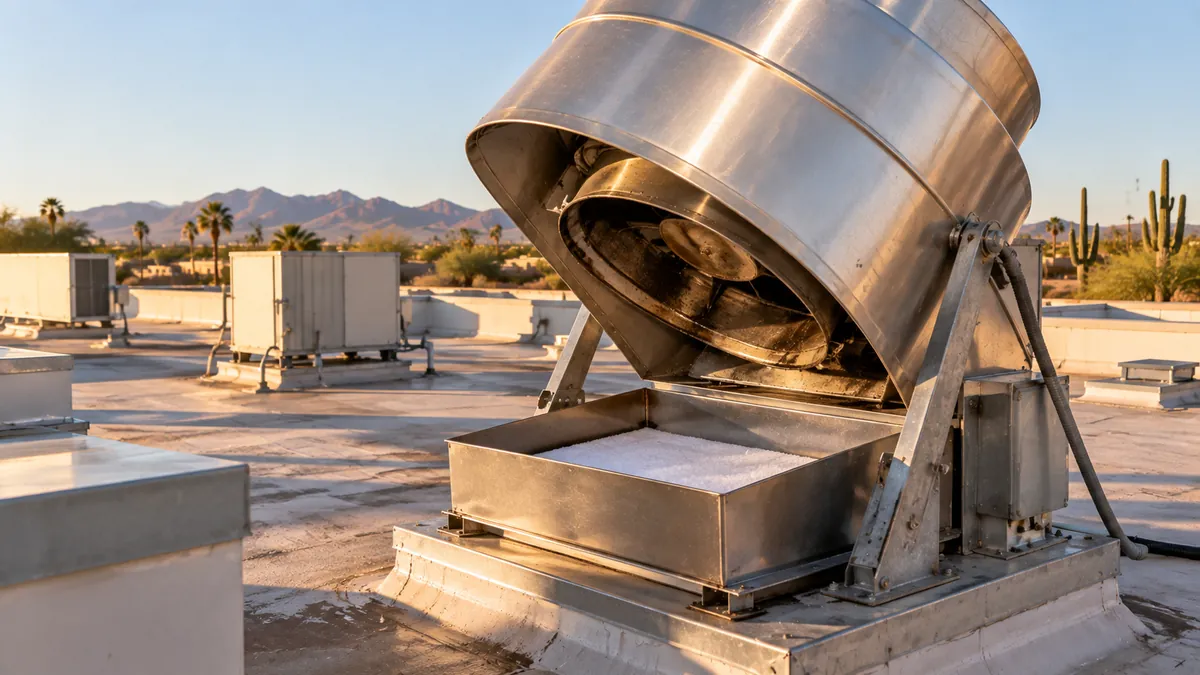
We install containment to the NFPA standard
Cleaning Resource Center sells rooftop grease containment systems from every major maker. We fit them to the exhaust fans on Phoenix restaurant roofs. We also sell and install hinge kits. The NFPA standard requires them on dome fans. We carry the cable stops that go with them too.
Grease comes out of your roof fan
When the kitchen cooks, the hood pulls hot, greasy air up the duct to an exhaust fan on the roof. Some of it cools inside the fan and turns back into liquid. On an upblast fan, the kind that blows air straight up, that liquid drains out a spout on the side of the housing. With nothing under the spout, it lands on the roof. Then it spreads. The NFPA standard for kitchen exhaust says that grease has to be contained.
The job starts with a look at the fan and the roof around it. We note how far the grease has run and what the roof is made of, since that decides which system will sit well on it. Then the containment goes in, sized to the fan. A drip cup goes on the spout. If the fan has no hinge kit or cable stop, we can fit those while we are up there.
After we finish, grease from the fan should end up in the containment or the drip cup and nowhere else. The containment sits flat around the fan, and the drip cup hangs level under the drain spout. If either one is missing or set crooked, grease gets past it. A tilted cup spills out one side before it is full. A gap in the containment lets grease run straight onto the roof beside the curb.
- Roof and fan checked before anything goes in
- Containment system sized to your fan
- Drip cup fitted to the fan drain spout
- Hinge kit installed on dome fans
- Cable stop that limits how far fans tip
A hinge lets the fan tip back
A dome exhaust fan sits on a curb, which is a raised box on the roof over the duct opening. To clean the duct under it, someone has to move the fan out of the way. With no hinge, that means unbolting the fan and lifting it off, which is heavy work and hard on the wiring. The NFPA standard requires a hinge on dome fans, both upblast and downblast, so the fan can tip back instead. When a fan is hard to move, the duct right under it is the part most likely to get missed.
The kit mounts between the fan base and the curb along one side. The fan stays where it is, but now it swings back on the hinge instead of coming off. We check that the curb is solid and square before the kit goes on. A hinge bolted to a soft or bent curb will not carry the weight of the fan for long. Then we tip the fan back once to check that nothing on the roof is in its way.
Once the fan has a hinge, it also needs a stop. Tip a fan past its balance point and its weight carries it all the way over, which yanks on its wiring. A cable stop is a short cable that catches the fan at a set angle. We set it so the fan opens far enough to clean under and then holds there. We sell and install cable stops along with the hinge kits.
Phoenix heat spreads grease across the roof
In a cooler city, roof grease firms up and mostly stays near the fan. Not here. A Phoenix roof in summer gets hot enough that grease stays soft and keeps running. A small drip at the spout turns into a long dark trail toward the low side of the roof. It pools at the seams and runs into the scuppers, the openings in the low wall that let water off the roof.
Around Phoenix, restaurants in strip centers and stand-alone buildings mostly have flat roofs. Many are sprayed foam with a coating on top, and others are built-up asphalt. Grease is hard on both. On foam, it softens and lifts the coating, and the bare foam under it breaks down in the sun. On asphalt, it breaks down the surface until it blisters and cracks. Either way, water gets in next, and the leak shows up in the kitchen ceiling.
The summer monsoon adds two more problems. Heavy rain washes loose grease off the roof and into the drains, where it can clog them. Blowing dust lands on soft grease and sticks. A containment pad caked in dust fills up and stops soaking up grease sooner than a clean one would. After a storm is a good time to go up and look at the fan. If the pad is dark and matted, it is full.
Containment only works if someone empties it
Grease on a roof is fuel. A kitchen fire that gets into the duct can reach the exhaust fan, since that is where the hot air is headed. If the roof around that fan is soaked in grease, a fire at the fan has somewhere to spread. Containment keeps that fuel in one place at the fan, where it can be pulled out and thrown away. That only holds while there is room left in it.
The drip cup is the part people forget. It hangs off the drain spout and catches what runs out between services. The NFPA standard caps that cup at one gallon. A cup that small fills fast on a kitchen that fries all day, and then grease spills over the lip and down the curb. Skipping that one small job puts grease right back where the containment was meant to keep it off.
You can check most of this yourself. Get on the roof and look under the fan spout, where dark, shiny patches or a soft spot underfoot mean grease is getting out. Check the drip cup and the pad too. If either is full, it needs to be emptied or swapped. And if a dome fan has no hinge on its base, it is not set up the way the NFPA standard asks.
Get your exhaust fan up to code
Call (602) 454-6790 and we will set a time to look at your fan and the roof around it.
Rated 4.0 on Google
We have not reprinted any of them here. The link opens our Google profile so you can read them at the source, which is worth more than a quote we picked ourselves.
Call now for a free containment quote
Yes, if your kitchen exhaust fan sits on the roof. The NFPA standard for commercial kitchen exhaust requires grease containment at the fan. Grease on the roof around the fan today means it is not being caught.
It is a hinge fitted between the fan base and the curb. With it, the fan tips back instead of being unbolted and lifted off. The NFPA standard requires hinges on dome fans, both upblast and downblast.
It catches a hinged fan at a set angle when someone tips it back. Without one, the fan can fall all the way over and pull on its wiring. We sell and install cable stops along with hinge kits.
Both. We distribute containment systems from every major rooftop grease containment manufacturer and install them on your roof. You can also buy hinge kits and cable stops from us and have us fit them.
Hood and duct cleaning removes the grease built up inside the system. The fan still puts grease out every day the kitchen cooks. Containment catches that grease between cleanings so it stays off the roof.
On a sprayed foam roof, grease lifts the coating and leaves the foam open to the sun. On a built-up asphalt roof, it breaks down the surface until it cracks. Summer heat keeps it soft, so it spreads farther than it would somewhere cooler.
Tell us about your kitchen.
Call us or send your details, and we will set up a free inspection of your exhaust.
- Monday to Thursday9:00 AM to 3:00 PM
- Friday to SundayClosed