
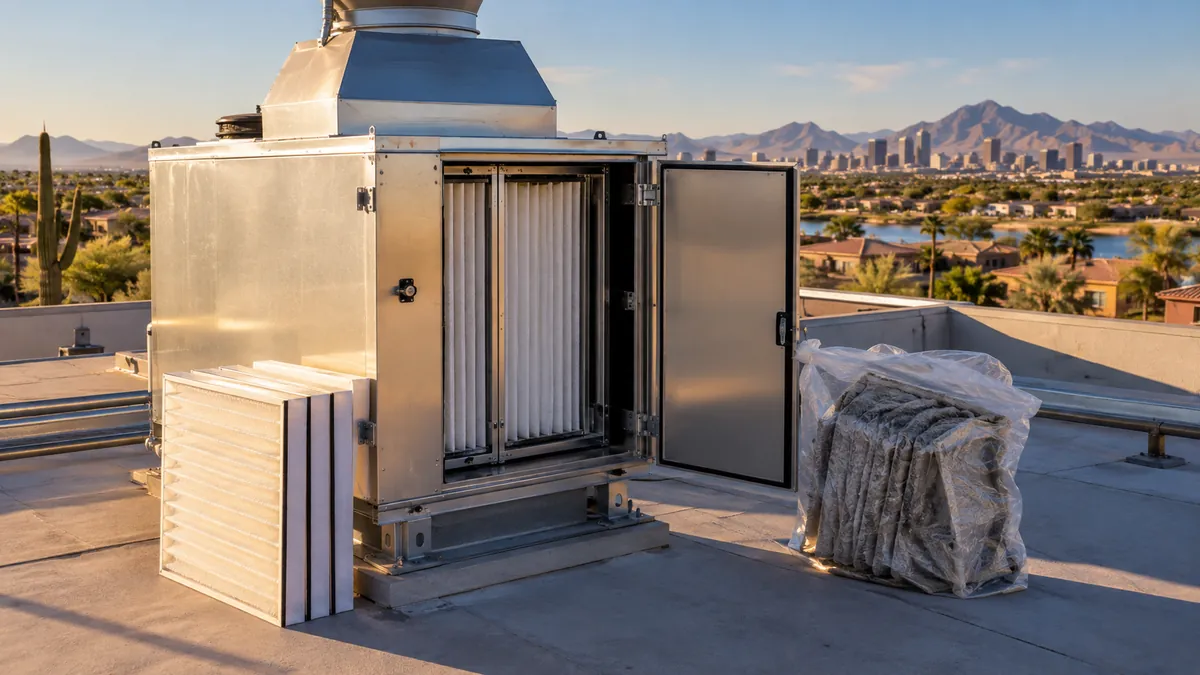
New filters go into a clean cavity
Cleaning Resource Center cleans and services the pollution control units on Captive Aire and Halton kitchen exhaust systems around Phoenix. You can also buy new filters straight from us.
Every PCU service follows the same order
A pollution control unit sits in the exhaust line between your hood and the fan. Inside is a row of filters, coarse at the front and finer behind, and each stage catches what the one before it missed. Our technicians work on Captive Aire and Halton units, and the first step is the same on both. We shut the unit down and open the access doors. Then every filter comes out, and the old ones get thrown away.
With the filters out, you can see the cavity they sat in. The cabinet floor and the filter rails collect grease that dripped off the front stages, plus dust pulled up from the kitchen. We clean the grease out of that cavity, and the rails get cleaned too. A new filter pushed into a greasy rail will not sit tight in its frame. Air then takes the easy path around the edge instead of going through the filter.
Then the new filters go in, each one in its own stage and facing the right way. Most of these filters are marked with an arrow for airflow, and one turned backward will not filter the way it should. Done right, every slot is full and no filter had to be forced into place. If you would rather keep spare filters on hand, you can buy them directly from us.
- Old filters removed and thrown away
- Filter cavity and rails cleaned of grease
- New filters installed in the correct stages
- Captive Aire and Halton units serviced
- Replacement filters sold directly to you
Clogged filters slow down your kitchen exhaust
Every filter in a PCU lets less air through as it fills. The fan keeps turning, but it moves less air because it is pulling against filters packed with grease and soot. In the kitchen, you see it first at the hood. Smoke that used to go straight up starts rolling out the front edge. The cooks feel the heat long before anyone looks at the unit.
Leave the front filters too long and grease starts getting past them. It soaks into the finer filters deeper in the unit, which are made to catch fine smoke, not liquid grease. A fine filter coated in grease has to be thrown out long before its time. Grease that gets past every stage ends up in the cabinet and the fan. Built up in a hot exhaust line, that grease can catch fire.
Many units give you a way to check before it gets that far. Some have a pressure gauge on the cabinet, and some have a control panel that warns when a filter stage is full. A reading that keeps climbing means the filters are filling. If your unit has a gauge, note the reading after a normal week of cooking and give it to us when you call. That tells us more about how much you cook than a date on a calendar does.
Phoenix heat and dust change the schedule
Around Phoenix, many PCUs sit on the flat roofs of strip centers, out in full sun most of the year. The cabinet is sheet metal, and on a summer afternoon it gets hot enough to burn a hand. Grease caught on the front filters stays soft in that heat. Instead of staying where it landed, it runs down the filter face and drips onto the cabinet floor. That is why the cavity cleaning matters more here than in a mild climate.
Monsoon season brings dust storms that coat everything in the Phoenix area. Fine dust gets into a kitchen every time the back door opens, and the hood pulls some of it up with the cooking smoke. Inside the unit, that dust mixes with grease into a thick paste on the front filters. Paste clogs a filter faster than grease alone. A kitchen that ran fine on its spring schedule can fall behind by late summer.
The sun is hard on the cabinet too. Rubber door seals on a rooftop unit dry out and crack after enough Arizona summers. A door that does not seal lets outside air and dust leak in, and that cuts the pull at your hood. When we have the doors open, we look at the seals and latches and tell you what we see. The cooler months are a good time to catch up, before the heat and dust come back.
PCUs keep smoke away from your neighbors
A PCU is usually there because the exhaust cannot go straight up and away from people. The kitchen might sit on the concrete ground floor of a building with wood-frame housing stacked above it. A lot of the newer mixed-use buildings in downtown Phoenix and Tempe are built that way. In other spots the duct has to end at a wall near windows or a patio. The unit cleans the smoke first, so the people living and eating nearby do not breathe it.
When the filters in that kind of unit go too long, the first people to notice are usually not in the kitchen. A resident upstairs smells fryer oil on the balcony, or a greasy stain shows up on the wall around the exhaust outlet. The complaint goes to the property manager, and the property manager calls the restaurant. By then the filters are well past due. The fix is a full filter change with the cavity cleaned out.
Strip centers have their own version of this. A restaurant may share a roof with a salon or a dental office. The neighbor's air conditioner can sit a short walk from your exhaust fan. If your PCU is letting smoke through, their rooftop unit can pull it right into their suite. In Mesa and Glendale, a lot of restaurants lease space in single-story concrete block strip centers. There, a clean set of filters is part of getting along with the tenant next door.
Need your PCU filters changed?
Call (602) 454-6790 with the make of your unit, and we will set up the filter change.
Rated 4.0 on Google
We have not reprinted any of them here. The link opens our Google profile so you can read them at the source, which is worth more than a quote we picked ourselves.
Call now for a free cleaning quote
It is a cabinet of filters in your kitchen exhaust line, between the hood and the fan. It pulls grease and smoke out of the air before the exhaust leaves the building. Kitchens usually have one because the exhaust ends near other tenants.
Our technicians are qualified to service Captive Aire and Halton pollution control units. If yours is another make, call (602) 454-6790 with the name on the cabinet and ask.
No. The old filters are removed and thrown away, then the cavity gets cleaned before new filters go in. The filters in these units are made to be replaced, not washed.
Grease and dust collect on the cabinet floor and the rails the filters slide on. That buildup keeps new filters from sitting tight, so air slips around them instead of going through. It is also grease left sitting in a hot exhaust line.
Smoke rolling out the front of the hood is the usual first sign. A cooking smell outside the building where there never used to be one is another. If your unit has a pressure gauge or a filter warning on its panel, that reading is the best guide.
Yes, you can buy replacement filters directly from Cleaning Resource Center. Call (602) 454-6790, Monday to Thursday from 9:00 AM to 3:00 PM, and have the make of your unit ready.
Tell us about your kitchen.
Call us or send your details, and we will set up a free inspection of your exhaust.
- Monday to Thursday9:00 AM to 3:00 PM
- Friday to SundayClosed